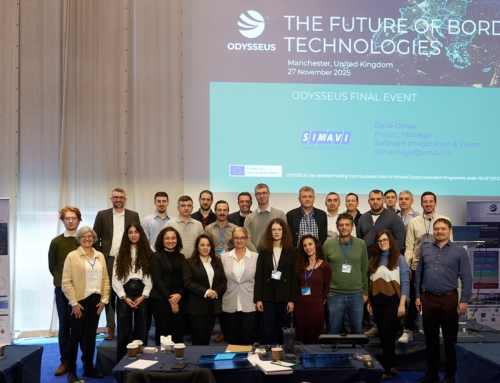



As the ODYSSEUS project reaches its conclusion, a key legacy is the delivery of a series of seven White Papers analysing how ODYSSEUS technologies and approaches relate to existing and emerging EU border-management policies, legal frameworks and ethical requirements.
Developed by multiple project partners and, in some cases, in collaboration with sister projects, these White Papers provide policy-oriented analysis, identify regulatory gaps and challenges, and offer recommendations to support the safe, lawful and future-proof deployment of innovative border-management technologies.
All White Papers are available in full on the ODYSSEUS website here.
Fostering Ethical-by-Design Approaches from the Early Stages of Technology Development
Authors: Marina Andeva, Olivia Ferrari (ISIG)
This white paper examines how AI can be integrated into border-management systems while respecting privacy, transparency, and fundamental rights. It explains the role of an ethical-by-design approach in aligning technologies such as identity verification, behavioural analysis, and decision-support tools with European regulations like the GDPR and the upcoming AI Act. The document highlights the practical difficulties of translating ethical principles into technical requirements, managing diverse regulatory frameworks, and balancing security with individual rights. It also underlines the importance of multi-stakeholder involvement, continuous risk assessment, and mechanisms for explainability and bias control.Entry/Exit System Platform Interfacing
Author: Martin David (Thales)
The paper compares ODYSSEUS platform goals, requirements and flows with Entry Exit System. Then it proposes two ways how the ODYSSEUS platform may integrate with the EES system: lightweight integration to satisfy short term need in near future and deeper integration with seamless flow to implement EES requirements in the platform. As a last part the white paper proposes a list of suggestions for implementation policy.Enhancing Seamless Border Crossings with Behavioural Biometrics
Authors: Leoni Chondromatidou, Niklas Palaghias (QBE)
The white paper explores how behavioural biometrics can strengthen digital border systems by enabling seamless, continuous, and secure identity verification for Digital Travel Credentials (DTCs) within the ODYSSEUS project. It describes the use of machine learning algorithms to analyse user interactions such as keystroke dynamics and device holding patterns providing a passive security layer that detects unauthorized access without interrupting the traveller. The document details the specific use case of passive user verification during mobile check-ins and outlines how the system complies with key EU legal frameworks, including the GDPR and the AI Act, by ensuring transparency, human oversight, and privacy-by-design. Finally, it provides implementation policy suggestions and highlights the impact of recognizing behavioural traits as valid inherence factors under regulations like PSD2, paving the way for standardized, high-risk AI border solutions.People Counting AI for Rapiscan’s Car View Technology
Authors: Charles Lamb, Andrea Cristini (RAPI)
This white paper reviews the AI-based people-counting component used within Rapiscan’s Car View system. It outlines the applicable sections of the AI Act, defines the equipment covered and summarises the required risk classifications. The white paper concludes with recommendations for compliant deployment and future improvements.ODYSSEUS Project Interactions with the Schengen Border Code
Authors: Harry Kellett, Monica Florea, Diana Antonescu, Dana Oniga
This paper analyses how ODYSSEUS technologies, including biometric tools, surveillance solutions and inspection systems, align with the legal requirements of the Schengen Borders Code. It identifies areas where ODYSSEUS supports existing provisions and highlights key considerations for future adaptation. The white paper concludes with findings relevant to operational deployment and policy evolution.Strengthening Security through EU-Funded Research & Innovation: Advancing Border and Forensic Capabilities
Joint white paper with FLEXI-cross, TENSOR, TENACITy
Authors: Monica Florea, Dana Oniga, Diana Antonescu, Dimitris Kassimis, Martin David, Harry Kellett
This joint white paper discusses lessons learned across four major Horizon Europe security projects. It outlines common challenges in border management, digital forensics, use cases and standardisation activities. The document highlights opportunities for cross-project collaboration and provides a consolidated view of how EU-funded innovation can support more efficient and interoperable border-security ecosystems.The Deliberate Exposure of Humans to Radiation for Non-Medical Imaging Purposes in Border Security Applications
Author: Harry Kellett (RAPI)
This white paper examines the regulatory and ethical implications of using imaging systems that emit ionising radiation in border-control settings. It assesses justification requirements, operational risks and the balance between detection capability and the protection of travellers’ health. The document concludes with policy suggestions and key findings on how such technologies should be evaluated before deployment.
Together, these White Papers form a coherent policy knowledge base supporting policymakers, practitioners, researchers and technology developers working in the field of European border management. As ODYSSEUS concludes, the White Papers remain available as a long-term reference for future research, deployment activities and policy development.